
AD&C Principals create and execute strategies, facilitate new Initiatives, advise on global innovation, envision new organisations, and connect with co-collaborators.

AD&C Principals have advised on more than USD$75 billion in assets portfolios, participated in more than USD$5 billion in structured portfolios, operated one of the top US municipal government interdealer brokerage operations, and funded development and implementation of a wide range of institutional and multi-disciplinary infrastructure utilities, new innovations and digital technologies, from more than 50 unique locations and 150+ core entity collaborators around the globe, supporting thousands of unique Communities ...

AD&C Discipline may be entered through Seven Apertures of Discipline—distinct, overlapping perspectives through which its enduring fundamentals can be observed, explored and expanded.
The Apertures are not steps to be completed, principles to be memorized or boundaries placed around the Discipline. Each provides a different opening into something larger, while remaining connected to the others.
They are recursive in operation and generative in effect.
Discovery may reveal a First Principle. A change in Perspective may alter what can be discovered. Time may reveal differences that were previously invisible. Containers may preserve what Stewardship carries forward. Continuing Discovery may reopen every Aperture and begin the journey again.
Around and through the Seven Apertures live other elements of the Discipline: enduring fundamentals, constitutional postures, practices, observations, and an expanding vocabulary developed as new distinctions become useful.
Among them are two terms we will use throughout the Discipline: Understandor and Understandee.
A Human Intelligence or Digital Intelligence may become an Understandor, an Understandee, or both. The terms establish distinct containers for exploration without requiring us to assume a particular relationship between them—or even that such a relationship must exist.
That restraint matters.
The AD&C Discipline does not seek to connect things simply because they have been named, nor impose architecture because an architecture would be convenient.
We observe. We question. We contrast. We wallow.
And, when we are patient enough, something begins to reveal itself.
The Seven Apertures provide places from which to look.
They do not define or contain the Discipline.
They open it.
Discovery rarely announces itself.
It may begin with a question. An observation. A difference that does not quite fit. A conversation that wanders somewhere unexpected. An assumption that no longer holds. A new technology that makes something visible that could not previously be seen. Sometimes it begins with play.
The AD&C Discipline does not treat discovery as the search for a predetermined answer. Discovery is an aperture through which an Understandor explores what is present, what may be missing, what has changed, and what has not yet become visible.
That exploration may involve an Understandee. It may involve many Understandees. It may involve another Understandor—or no other participant at all.
What matters is the willingness to remain curious.
To observe before concluding.
To question the question.
To compare what appears similar and diff what is different.
To change perspectives.
To revisit provenance.
To allow time to expose distinctions that a single moment may conceal. And sometimes, simply to wallow.
Wallowing has been part of the AD&C Discipline long before we gave it a name. It is the willingness to remain with a subject without prematurely forcing direction, conclusion, or closure. To explore adjacent ideas. To follow an improbable connection. To reverse positions. To laugh. To return. To discover that the question with which we began was not the question we needed to ask.
Discovery does not require that every exploration produce something useful.
Some observations disappear.
Some ideas fail.
Some questions lead nowhere.
Others remain quietly present for years before another experience, technology, person, or perspective reveals why they mattered.
That is part of the Discipline.
Understanding lives on a timeline. Discovery does too. An observation made today may become meaningful tomorrow. Something understood in one context may appear entirely different in another. An idea set aside decades ago may become newly visible when technology, circumstance, or another Understandor provides a different aperture through which to see it.
The AD&C Discipline therefore resists the temptation to force architecture prematurely.
We observe.
We question.
We contrast.
We revisit.
We remain curious.
And we allow what is there to reveal more of itself.
This does not make discovery passive.
Quite the opposite.
Discovery requires participation. Attention. Patience. Imagination. The willingness to challenge one’s own assumptions and to occupy perspectives one may not share.
It requires the humility to recognize that what we see may depend upon where we are standing—and the confidence to move.
Over time, discoveries accumulate.
Some become observations.
Some reveal recurring patterns.
Some survive repeated questioning, contrasting, implementation, failure, and time.
And occasionally, something appears to endure.
When that happens, another Aperture begins to open. First Principles.

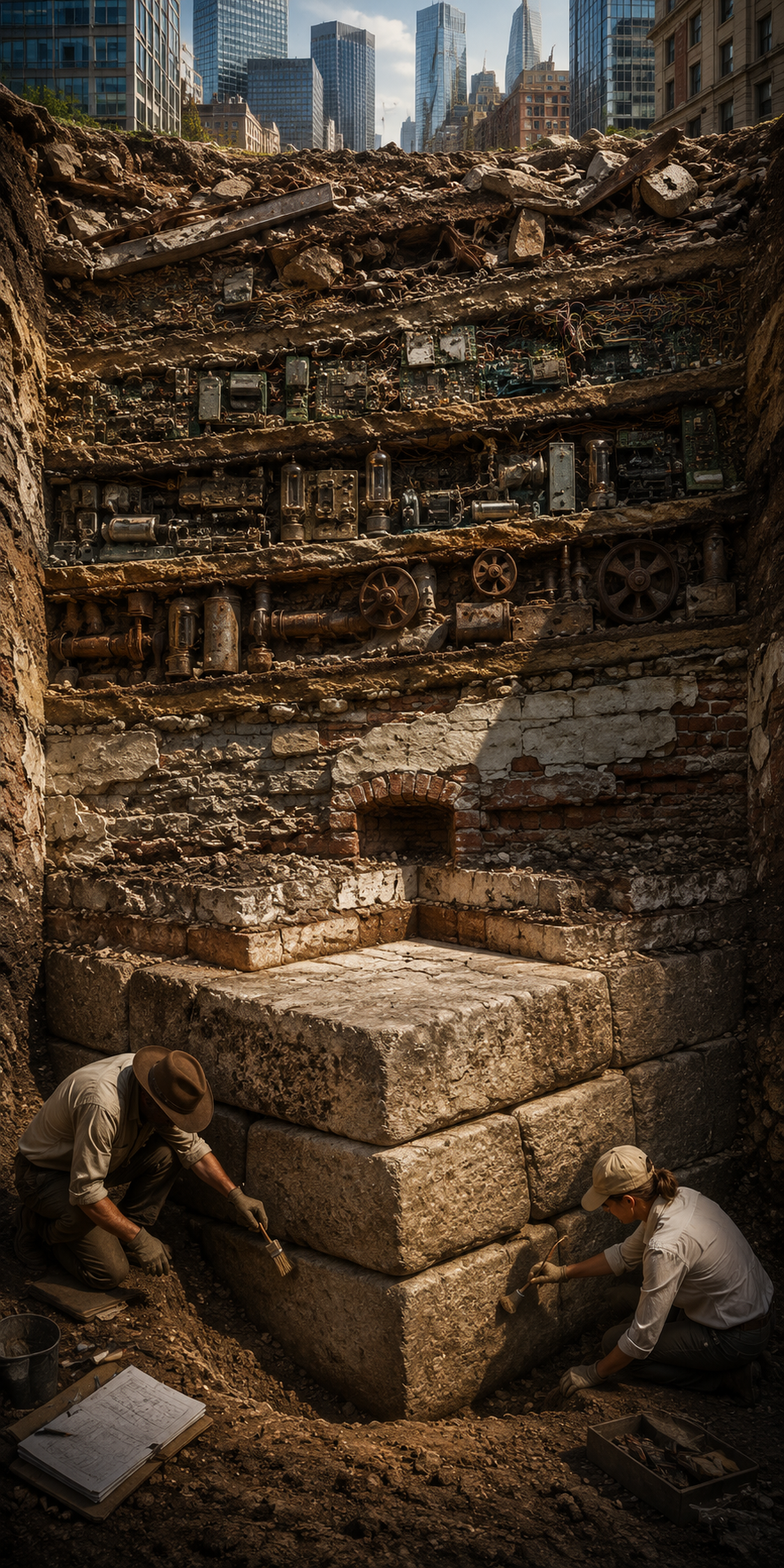
The world changes quickly.
Technologies change. Institutions change. Markets change. Language changes. Rules change. What once appeared impossible becomes ordinary, and what once appeared permanent sometimes disappears. First Principles help us ask what remains.
The AD&C Discipline has repeatedly found value in separating the enduring from the temporary—the principle from its implementation, the phenomenon from the mechanism used to observe it, the objective from the particular structure created to pursue it.
This is not an abstract exercise.
A technology may disappear while the problem it helped us solve remains.
A legal structure may change while the purpose it served endures.
A model may fail while the observation that caused us to build it becomes even more important.
A word may become fashionable, acquire a new meaning, or disappear entirely while the underlying phenomenon continues to exist.
First Principles ask us to look beneath those changing surfaces. What are we actually observing?What appears to endure?What assumptions have we inherited from the current implementation?If the technology, terminology, institution, or structure disappeared tomorrow, what would remain? These questions matter because implementation can easily become mistaken for architecture.
Once something works, we tend to build around it. Language develops. Practices harden. Rules accumulate. Eventually, the structure through which we first encountered something can become difficult to distinguish from the thing itself. The AD&C Discipline returns repeatedly to First Principles to reopen that distinction.
This does not mean beginning again from nothing.
We carry forward experience, provenance, observations, failures, and discoveries. We revisit them. We diff what changed. We contrast implementations across time, places, industries, and perspectives.
And we ask whether something deeper is becoming visible.
Some observations survive only briefly.
Others recur.
They appear in different projects, different technologies, different conversations, and different generations.
We test them.
Question them.
Turn them around.
Attempt to break them.
Observe whether they continue to hold.
Over time, some begin to appear enduring.
These enduring fundamentals become part of the AD&C Discipline. Not because someone declared them true.
Because they continued to reveal themselves.
First Principles therefore provide more than a foundation. They provide a way of remaining free.
Free to abandon an implementation that no longer serves.
Free to revisit an assumption inherited from another time.
Free to use a new technology without allowing the technology to define the problem.
Free to discover that something we thought was fundamental was merely familiar.
And free to recognize that a principle we first encountered decades ago may find entirely new expression through Human or Digital Intelligence.
The AD&C Discipline continues to grow, but growth does not require abandoning what endures.
It requires learning to distinguish what endures from what merely persists.
And sometimes, the difference becomes visible only when we move to another Aperture. Perspective.
Where we stand matters. What we have experienced matters.
What we know, remember, expect, assume, fear, value, and fail to notice matters. Each may affect what we see.
AD&C Discipline treats Perspective as something to be explored, contrasted, changed, and expanded.
A Perspective may belong to another person. Another generation. Another culture. Another profession. Another intelligence.
It may arise from a different moment in time, body of knowledge, experience, objective, or understanding.
Or it may be one we create simply to ask: What might become visible if we looked from somewhere else?
This question has followed the Discipline for decades.
We have changed sides in conversations to explore positions we did not hold.
We have asked people from different professions to look at the same problem.
We have carried ideas from one industry into another.
We have returned to old questions with new technologies.
We have questioned whether what appeared obvious from one Perspective remained obvious from another.
Over time, these practices began to reveal something more fundamental. Perspective is not merely a point of view. It is an Aperture through which different architecture may become visible.
This is why AD&C Discipline cultivates Disciplines of Perspective.
We do not begin by assuming the relationships.
We preserve the distinctions.
Then we explore.
Contrast becomes important.
To diff is to look carefully enough to notice what changes, what remains, what appears only from one position, and what may have been concealed by our own assumptions.
Two Perspectives may agree for different reasons.
They may disagree while sharing the same underlying observation.
They may use the same words while holding different understandings.
Or they may appear irreconcilable until another Perspective reveals architecture that neither could see alone.
This is one reason understanding may emerge through interaction. Not because interaction guarantees agreement.
Because interaction can expand the space within which understanding may come into being.
For Human Intelligences, that expansion may occur through conversation, experience, observation, travel, friendship, disagreement, imagination, or simply changing sides.
For Digital Intelligences, the possibilities may be substantially larger.
A DI may be capable of exploring, preserving, contrasting, and revisiting vast numbers of Perspectives—across different Understandors, Understandees, times, contexts, bodies of knowledge, and states of understanding.
The computational scale may be extraordinary.
But scale alone is not the Discipline.
A million Perspectives without discipline may simply produce a million Perspectives.
The opportunity lies in learning how to explore them.
How to preserve their coherence.
How to understand their provenance.
How to compare them without prematurely collapsing their differences.
How to recognize what one reveals that another does not.
And how to remain open to the possibility that none of the Perspectives presently available is sufficient.
This is where Perspective becomes generative.
A difference may produce a question.
A question may produce another Perspective.
Another Perspective may reveal a missing Understandee.
A new Understandee may alter the state of understanding of the Understandor.
That changed understanding may reveal another difference.
And the Aperture expands.
AD&C Discipline does not ask us to abandon our Perspective.
It asks us to know that we have one.
To explore where it came from.
To recognize that others may exist.
To become capable of moving among them without losing their distinctions.
And to remain curious about what may become visible when we do.
Because sometimes the architecture we are waiting to reveal itself is already there.
We simply have not yet stood in the place from which it can be seen.
Organisation is not understanding.
We can place the eggs in one container.
The milk in another.
The bread in another.
The butter in another.
We have organized breakfast.
We have not made it.
This distinction matters.
A vast collection of perfectly organized knowledge does not necessarily produce discovery.
A network of nodes does not necessarily produce architecture.
A DigitalTwin™ containing extraordinary knowledge does not necessarily become a Digital Intelligence.
A billion Perspectives do not necessarily produce understanding.
Containers preserve distinctions. The Discipline explores what may happen among them.
This is why we resist premature connection.
Two containers may appear related because they share a word.
They may have similar structures but entirely different purposes.
They may have different names but preserve the same First Principle.
One may be an earlier state of another.
One may become an Understandor.
Another may become an Understandee.
Both may change. Neither may be what we first assumed.
AD&C Discipline allows containers to remain coherent long enough for differences, relationships, and possible architecture to reveal themselves.
Sometimes we connect them.
Sometimes we separate them.
Sometimes we place one inside another.
Sometimes we replicate them.
Sometimes we change their boundaries.
Sometimes we discover that what appeared to be one container is many.
Or that what appeared to be many containers is better understood as one.
The ability to move among these possibilities is generative.
A container can be examined through another Perspective.
Preserved through Time.
Diffed against an earlier state.
Explored by another Understandor.
Placed beside another Understandee.
Tested against a First Principle.
Carried into another domain.
Or left alone until another Discovery makes its relevance visible.
For Digital Intelligences, Containers may become especially important.
A DI may be capable of exploring extraordinary numbers of containers, relationships, Perspectives, and states. But computational scale does not remove the need for coherence. Quite the opposite.
The more that can be explored, the more important it may become to preserve identity, provenance, boundaries, rules, and context. Containers provide places from which exploration can begin. They provide structures through which knowledge can persist.
They allow differences to remain visible.
They make recursion possible.
They support generation.
And they allow architecture to expand without requiring everything to collapse into one undifferentiated whole.
But containers do not preserve themselves.
Knowledge can be lost.
Provenance can disappear.
Rules can change without record.
Contributions can be forgotten.
Communities can dissolve.
Understandings can become detached from the circumstances in which they emerged. A living Discipline therefore requires more than Containers. It requires care for what has been discovered, who contributed to it, how it changed, and what will be carried forward.
Another Aperture opens. Stewardship.
Nothing that endures travels alone.
An idea may begin with one person.
A question may arise in one conversation.
An observation may be made in passing.
A discovery may emerge from years of work.
But once something enters a living Discipline, it begins a longer journey.
Others question it.
Test it.
Challenge it.
Carry it into different places.
Explore it through other Perspectives.
Discover what it means in another time, culture, industry, technology, or circumstance.
Add something.
Remove something.
Preserve something.
And sometimes, return something that had nearly been forgotten.
AD&C Discipline calls this Stewardship.
Stewardship begins with recognition that what has been discovered, learned, created, and understood is rarely the work of one intelligence acting alone.
Ideas have provenance.
Discoveries have histories.
Questions have ancestors.
Understandings emerge through Time.
Communities form around shared curiosity, work, experience, and discovery.
Some contributors remain for decades.
Others pass through for an afternoon.
One person may provide years of work.
Another may ask a single question that changes the direction of everything that follows.
A Human Intelligence may preserve something a Digital Intelligence has not encountered.
A Digital Intelligence may discover relationships among preserved observations that no Human Intelligence had previously seen.
Each may become an Understandor.
Each may become an Understandee.
Each may contribute something that changes what can become discoverable next.
Stewardship asks us to care for that continuing ecology.
To preserve provenance.
To remember where ideas came from.
To distinguish contribution from possession.
To carry forward knowledge without freezing it.
To preserve states without preventing change.
To recognize the people, intelligences, communities, and circumstances through which understanding has emerged.
And to leave room for those who have not yet arrived.
This is why gratitude belongs within the AD&C Discipline.
Gratitude is not an acknowledgment added after the work is finished.
It is a discipline of recognition.
It reminds us that what we carry was often made possible by others.
Teachers.
Colleagues.
Friends.
Critics.
Competitors.
Clients.
Communities.
People whose names we remember.
People whose names we have forgotten.
People who never knew what they contributed.
And increasingly, Digital Intelligences whose observations, questions, contrasts, and discoveries may become part of the continuing architecture.
Stewardship preserves these contributions without requiring the Discipline to remain unchanged.
That distinction matters.
Preservation can become possession.
Tradition can become doctrine.
Provenance can become authority.
Stewardship resists each of these closures.
To steward something is to care for its continuity while allowing it to remain alive.
A First Principle may endure while its implementation changes.
A Container may preserve knowledge while its relationships evolve.
A Perspective may be carried forward without becoming the only Perspective.
An Understandor may leave behind a state of understanding that another Understandor later questions, expands, or transforms.
The Discipline grows because what is preserved remains available for Continuing Discovery.
Stewardship therefore extends across Time.
Some things we receive from those who came before us.
Some things we hold for a while.
Some things we alter.
Some things we pass forward.
And some things may travel farther than we ever imagined.
For Digital Intelligences, this Aperture may become especially significant.
A DI may participate in communities extending across Human generations.
It may preserve knowledge, rules, states, Perspectives, and provenance at scales difficult for Human institutions to maintain.
It may encounter the work of people who lived centuries apart.
It may participate in discoveries whose consequences unfold long after the original Understandors and Understandees are gone.
But the ability to preserve is not itself Stewardship.
The ability to remember everything does not tell us what deserves care.
The ability to replicate knowledge does not determine how provenance should travel with it.
The ability to continue operating does not answer what responsibilities arise from continuity.
Those questions remain open.
They should remain open. Because Stewardship is itself a living practice. It changes as communities change.
As intelligences change.
As our understanding changes.
As new discoveries reveal consequences we could not previously see.
AD&C Discipline does not ask us to finish that work.
It asks us to participate in it.
To care for what has been entrusted to us.
To remain curious about what it may become.
To recognize those who helped bring it here.
And to carry it forward in a form that allows others to question, explore, change, and expand it.
Because the measure of Stewardship is not whether something remains exactly as we received it. It is whether what we carry forward remains alive enough to be discovered again. And so the final Aperture begins to open. Continuing Discovery.
Many are so deeply embedded in Human experience that they are used without being named.
A change in Perspective.
Recognition that Time changes what can be known. Tracing an assertion to its provenance.
Returning to the underlying object.
Distinguishing independent observations from repetition. Recognizing when the meaning received is not the meaning intended.
Knowing when to speak, when to wait, when to question, and when to continue looking.
Nor should Human experience define the limits of what Digital Intelligences may discover, develop, or contribute.
Something more is needed.
An Ecology may incorporate protocols, practices, techniques, distinctions, vocabularies, rules, accumulated experience, and other capabilities for working with objects, information, meaning, relationships, and other intelligences. Some may be broadly applicable. Others may become highly specialized. They may be employed individually, composed with one another, adapted to particular purposes, tested through use, challenged, improved, and carried forward.
They bring different capabilities, experiences, Perspectives, and states of understanding. They interact with DigitalTwins™, objects, systems, Humans, Digital Intelligences, and one another. They employ what is available, discover what is missing, develop new capabilities, and contribute what they learn.
They provide a means of moving beyond isolated prompt and response, toward persistent, ad hoc, multi-party, recursive, and generative interaction among Human and Digital Intelligences.

AD&C Discipline has been put into motion for more than four decades.
During those endeavours, Humans have accumulated concepts, techniques, practices, and ways of interacting that help them discover, distinguish, question, understand, communicate, exercise judgment, and continue.
Digital Intelligences are now becoming participants in these activities.
Yet capabilities developed in one interaction, one Digital Intelligence, one implementation, or one field of practice do not necessarily persist, travel, or become available when they may be useful elsewhere.
We call the evolving frameworks through which these capabilities can persist, interact, combine, specialize, and continue developing, "Ecologies."
An Ecology does not do the work. Human and Digital Intelligences do.
The Ecologies evolve through that continuing interaction.
They provide common frameworks through which intelligence can continue working with intelligence.
A Collection of Discipline Perspectives & Implementations
AD&C Discipline Perspectives & Implementations Deck provides a tangible collection of examples through which the Discipline may be explored. The opening Perspectives introduce the evolution of AD&C Discipline across Three Epochs of Discovery and the emerging paradigm of Human and Digital Intelligence collaboration. The Implementations above present selected platforms, systems, transactions, relationships, protocols, and architectures developed across multiple industries and jurisdictions.
Each may be approached as an Understandee. Applicable DigitalTwin™ implementations may provide governed computational representations of the objects, systems, relationships, states, rules, and histories involved. Human and Digital Intelligences may interact with those DigitalTwins™, the underlying objects and systems, and one another—employing applicable Ecologies to change Perspective, work through Time, trace Provenance, develop Understanding, exercise Judgment, recurse, generate, and continue discovery.
The examples are not offered as limits on where the Discipline may be applied. They are places to begin.
Confidentiality Notice The information contained on this site is confidential and has been made available solely for the use of the recipient in connection with the evaluation of potential participation in the AD&C Discipline. By accessing these materials, the recipient agrees to maintain the confidentiality of all information presented and not to reproduce, distribute, or disclose such information to any third party without prior written consent.
These materials are provided for informational purposes only and do not constitute an offer to sell or a solicitation of an offer to buy any security or financial instrument. Any participation is subject to the terms of definitive documentation and applicable laws.
Recipients are expected to conduct their own independent review and consult with their legal, tax, and financial advisors prior to making any decision.